
Sizing based on demand, not guesswork
We match tank capacity and recovery rate to your household's usage and fuel type. Undersized heaters run out of hot water; oversized ones waste energy and space.
Leaking or worn-out tank? We size the right replacement, haul the old one away, and test the new heater before we leave.
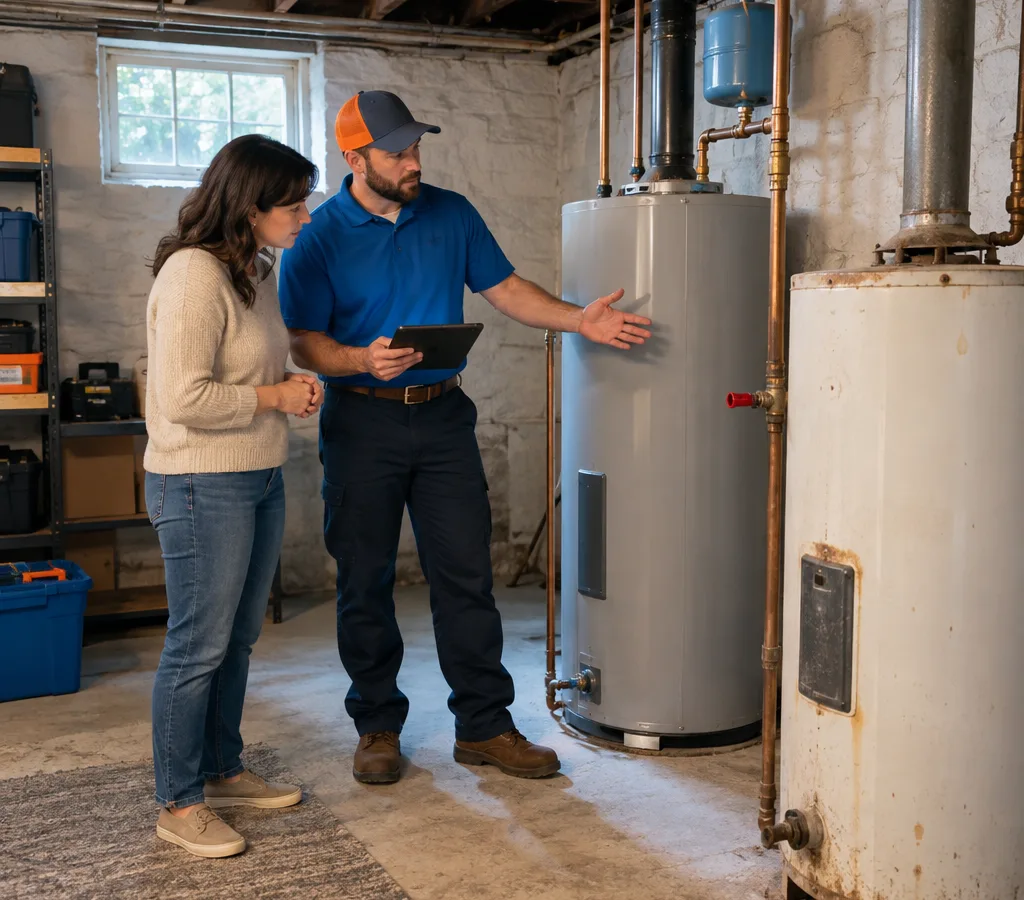
Short showers, rusty or smelly water, a puddle by the tank, or a unit that won't stay lit usually mean it's time to look at a new heater. Replacement is straightforward when it's planned well, but sizing, venting and safety details can't be skipped.
We confirm why the old unit failed, size the new one for your household, and install it to current safety practices. Many Lancaster homes have heaters tucked into tight basements, utility closets or near finished space, so access, drainage, combustion air, vent routing and shutoffs all shape the plan.
If the problem turns out to be a part, repairing your current heater may be the better value, and we'll tell you so before anything gets replaced.
We match tank capacity and recovery rate to your household's usage and fuel type. Undersized heaters run out of hot water; oversized ones waste energy and space.
On gas units we verify venting and combustion safety. On electric units we check wiring and breaker compatibility. Connections are made to cut down future leak points.
You see the installation approach, the equipment options and what's included, so you can choose based on lifespan, warranty length and budget.
The old heater is disconnected and carried out carefully. The new one is leveled, secured, filled, purged of air and tested before we leave.
We look at shutoffs, drain access and clearances so the next flush, anode check or future replacement isn't a headache.
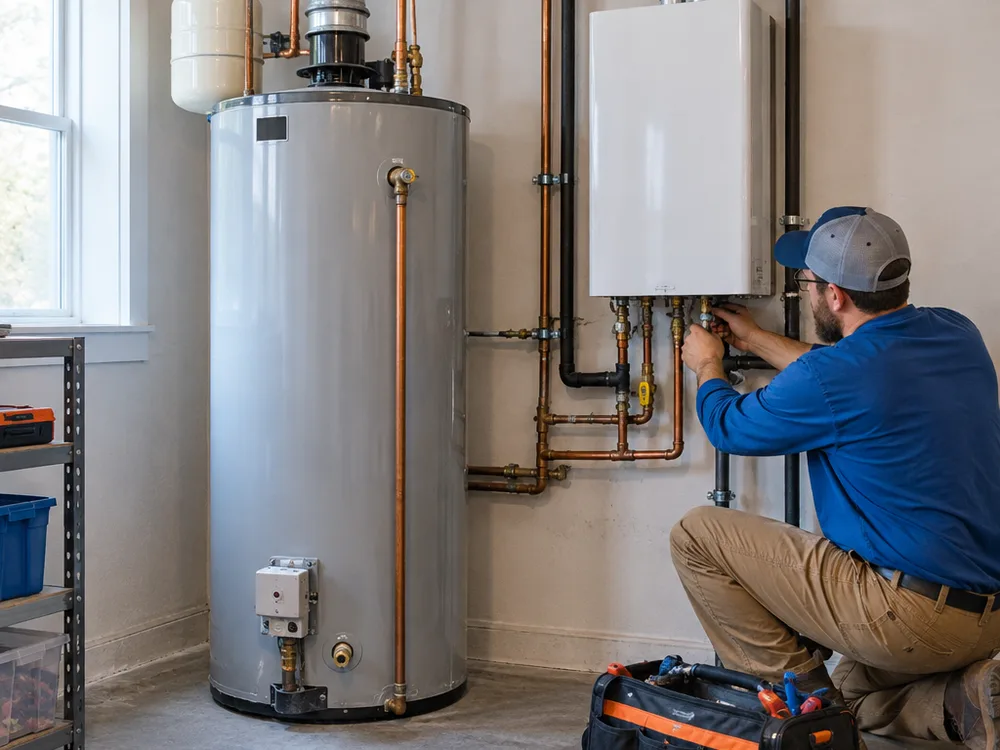
Most replacements follow one of two paths: a tank swapped for a similar tank, or a conversion to tankless. The right choice depends on fuel type, venting, space and how your household uses hot water.
A tank is usually the simplest like-for-like swap. It fits best when the current setup already has the right gas venting or electric wiring and you want a predictable install with few changes.
Tankless makes sense when you want floor space back or keep running out of hot water. Conversions may need new venting, more gas-line capacity, a condensate drain and electrical work. If you're switching to tankless, we plan those steps before any work starts.
In basements with narrow stairs or low clearance, we plan removal and placement so the new unit stays safe and serviceable. Near finished storage or living space, leak protection and shutoff access get extra attention.
Step 1 of 5
We check whether it's a leaking tank, failed heating parts, venting or combustion trouble, or a control issue. If a repair is realistic and safe, you hear that first.
Step 2 of 5
We size the unit, confirm fuel type, and review venting, drain access and clearances. Your options balance budget, warranty length and efficiency.
Step 3 of 5
We shut off water and fuel or power, protect the floor, and check shutoff valves and connection points. Unreliable valves or piping are dealt with, not ignored.
Step 4 of 5
The old unit is disconnected and carried out. The new heater is set, connected, vented as required, filled, purged of air and brought up to temperature.
Step 5 of 5
We check for leaks, proper draft where it applies, and the temperature setting, then show you how to operate and care for the new heater.
A standard tank replacement typically runs $1,200 to $3,500 installed, with many straightforward swaps landing around $1,600 to $2,600. Tankless replacements or conversions often run $3,000 to $7,500+ because venting, gas-line capacity, condensate drains and electrical upgrades may be needed.
Final price depends on fuel type, size and efficiency, venting changes, access through tight basements or stairs, code-related updates, and whether shutoff valves or piping need replacing. We confirm the exact price after seeing the installation.
Water around the tank base? Call before it floods the floor.
Replacement is usually the right call when the tank itself is leaking, has internal corrosion, or the repair would cost close to a new heater. A wet base or rust at the seams strongly suggests the tank has failed.
A like-for-like tank swap is commonly finished the same day once the right unit is on hand and the existing connections are workable. Conversions take longer when venting, gas capacity or electrical work has to be added.
Yes, but access affects the plan and sometimes the equipment. We plan the carry-out, the set location and service clearances so the new heater can be maintained later.
It depends on where you live and what changes. In the City of Lancaster, permits go through the Bureau of Building Code Administration, and each township has its own code office. We confirm what applies to your job when we quote it.
Sizing depends on the number of people, how many showers run at once and whether the heater is gas or electric. We size for real demand so normal use doesn't run you out of hot water.
Yes. Removal and disposal are typically part of the job. We protect steps, floors and finished areas during carry-out and flag any unusually difficult access up front.
Tell us what you're seeing, like leaks, no hot water, rumbling or pilot trouble, and what type of heater you have. We'll confirm the best option and the price before work begins.